Tag Archives: Sarajevo Film Festival

We Shall Live Together Interview with director Damir Markovina

by Dimitra Kouzi

“We Shall Live Together” was the campaign slogan of an opposition MP in the Bosnia and Herzegovina parliament who refused the nationalist logic of every side as the war began. It is also the title his son, Damir Markovina, gives to the film in which he asks his father, thirty years on, what that choice cost the family — and whether it was worth it. As the world marked the 30th anniversary of the Dayton Peace Agreement, Damir Markovina's We Shall Live Together celebrates its world premiere in the Documentary Competition of the Sarajevo Film Festival 2026. 

Watch the trailer

This film is deeply personal because your father is both its subject and someone with whom you have had a complicated relationship. At what point did you realise that this needed to become a film rather than remain a private family conversation?
Tolstoy teaches us that all unhappy families are unhappy in their own way, while happy families are largely alike.
My experience is different.
Reflecting on how best to portray the war we lived through in Bosnia and Herzegovina, I realised that my family is by no means alone in a struggle to accept the new post-war society and its rules. After nearly fifty years of living together, many families in BiH found themselves excluded by the new nationalist divides and factions.
That fact—combined with my father’s unique position as a witness (an opposition MP in Bosnia and Herzegovina Parliament at the outbreak of the war)—enabled me to use my family and our history to tell a universal story about the onset of war and the choices it demands. It is certainly, uniquely, our story—a family story—yet one that, through recognisable archetypal family dynamics, I hope resonates with anyone who has gone through a similar experience.

Damir and Roko Markovina

Your father’s story challenges the dominant narratives about the Bosnian War by focusing on someone who rejected nationalism on all sides. What responsibilities did you feel towards the people, places and histories represented?
I think that responsibility boils down to two main issues: First, it is very easy to fall into the trap of oversimplifying the incredibly complex wartime situation in Mostar—and, more broadly, in Bosnia and Herzegovina. In this film, I wanted to preserve the full complexity of that narrative through facts backed by archival footage or personal testimony, while stripping away all speculation and personal opinions regarding the causes of the hostilities—of which I have a great deal in my source material. If it isn’t entirely clear why, at one moment, Bosniak and Croat forces were fighting side-by-side against Serb military and paramilitary units, only to become enemies in the next—or why my father’s loyalty was constantly being questioned due to his political views or his family members’ ethnicity—well, it wasn’t clear to us either amidst the chaos of that war. I want the traces of that chaos and uncertainty to be palpable in my film.
The second issue is as much a matter of dramaturgy as it is of family relationships: how do you make a film that doesn’t simply become a monument to a single moral choice or a paean to a moral man? I chose to re-examine my father’s convictions thirty years later and confront him with the price his deeply moral choice exacted from the rest of our family—a price we all paid. Whether that choice was right, necessary, or too costly is for the audience to judge.
I simply believe that every generation owes the next an answer to the question of why the world they left behind is the way it is, and whether—at some point or place—they could, or should have acted differently.
The film examines the personal consequences of resisting nationalism at a time when nationalist movements are once again reshaping politics around the world. What new insights did you gain about the relationship between moral conviction, personal sacrifice, and the relevance of these choices today?
I know for sure that nationalism is a key building block of fascism. I also know how terribly easy—and highly expedient—it is to join the herd mentality and regard the mere accident of birth into a particular family or nation as one’s supreme achievement. True understanding, innovation, or creativity require far greater effort—effort that most people are unwilling to make. Hiding behind a piece of colourful fabric representing some small, artificial political construct in power—what every nation basically is—offers a much faster route to success and recognition in a nationalist society.
This is true even though no one—especially in the historically complex Balkans—can truly vouch for the intimate erotic life of their own ancestors.
One must stand up to this fascism at all times, even through small, daily actions, even if your surroundings will not—that is what I learned from my father—especially if, in today’s Europe, such a struggle might be doomed to failure from the start, a prospect my father finds so difficult to accept.
My ideal remains a borderless Europe—a community of free spirits that transcends national and racial prejudices and divisions—equality, brotherhood and liberty.The title, We Shall Live Together, carries both hope and irony. What does that phrase mean to you today, more than thirty years after the war?
The hope, I suppose, that people will eventually realise that the neighbours with whom they share their lives are closer to them than some distant person with whom they share nothing but a label of national identity.
The—likely utopian—idea that it is indeed possible to overcome religious, racial, sexual or class divisions.
That sentence was the slogan of my father’s political campaign. They lost by a landslide, but the winning side did not create a better or happier society. Perhaps it is time to try an alternative.
Did you have a clear idea of what the film would look like before you began filming?
No. Never. And for someone like me—a rather obsessive-compulsive person—this represents huge progress, whether in preparation, the actual filming, or especially the editing. I do always keep in mind my conclusions about what the film is really about—and I have ideas that I want to try, but they don’t always work. I am constantly learning the value of adapting my preparation to each set and how to accept and manage the circumstances arising from situations I cannot fully control. I strive to choose the right collaborators who can help me understand the language of the footage we’ve shot and how to translate it into a film. It is a process that is incredibly slow and painful, yet deeply rewarding once we realise the direction we need to take. But for me, patience and persistence are the two main weapons. If you’re there often enough, long enough, and ready—the life you’re filming will offer you a lot to work with. Otherwise, I’ll constantly be trying to bend it to fit my narrative, which works only up to a point—you can nudge it, but if you insist it becomes something very fake and plastic at the speed of light. I don’t want to change the world; I want to ask a question about one specific part of it: what the hell is this? How did it happen?
Now, I think it’s better to let the filming process change me instead.
What kinds of risks did you have to take? In what ways was your comfort zone challenged?
I don’t think I ever stayed within my comfort zone while working on this film. On one hand, I was provoking my own family with memories of a barely suppressed past—the source of many of our conflicts—thereby risking my formative family relationships; on the other, I chose locations that would not invoke that past: Mostar, the Parliament of BiH, a cramped family lunch that devolves into an argument and a confrontation; a search for archival material testifying to a past that differs from the currently accepted canon, and so on.
Fortunately, I had wonderful partners—especially my producer Tamara Babun Zovko, editors Marta Bregeš and Vlado Gojun, and others—who stood in my corner and offered the right advice whenever I didn’t know exactly how to proceed.
Of course, there was always the risk that the role of the son would compromise the role of the director, but I had resolved that within myself before filming even began: I have a deeply personal reason for making this film, and that reason always comes first.
If I could continue my life without making it, I most certainly would do so.

Producer: Tamara Babun Zovko

What did your instincts help you do while you were shooting? Were there moments when your instincts as a son conflicted with your instincts as a director?
As for instinct, I’ll stay within the same set of Viktor Kossakovsky’s rules of filmmaking: “You need your brain both before and after filming, but don’t use your brain during filming. Film using your instinct and intuition.”
I find this simple rule true and irreplaceable.
Your background is primarily in acting. How did your experience of performance, emotion and human behaviour influence your directing?
For me, the greatest truth about acting, especially in theatre, lies in the fact that it exists only in the moment of performance.
In many decades as a professional actor, that always struck me as the hardest part: to be as present as possible in the moment itself—in that elusive “now” that you cannot even think about, because it has already passed the instant you do.
To me, this means not wasting time analysing what you have just done wrong or right, nor anticipating far into the future what might happen; it also means developing a real capacity to adapt to any change or stimulus and to respond quickly.
These principles resonate deeply with my own filmmaking process.
What did you learn from making this film, including about yourself?
I think I closed a very long circle of my life, and I’m happy for it.
As I’m still learning and polishing my filmmaking skills, this project gave me, through collaborations with a really fantastic crew of authors, a big new set of tricks that I’m really looking forward to developing in my future work.
Tell me about some “magical” moments.
Many, that’s the most beautiful and rewarding part of every project, so I don’t want to pull just one out, and I’m a bit superstitious—so let’s keep some mystery about those intact—but what I really think is that somehow you earn them by your continuing presence and effort.
What role do silence, gesture and observation play in the film’s understanding of your father?
In general, in an observational documentary, I think there is no alternative to patience. Every character, and my father is no exception, goes into a film about himself with a preset idea of who he is and how that whole film or a single scene should look.
My experience is that only with long shots, with extended recording time, and only after that initial barrage of words in a prepared monologue or statement does some interesting truth of that character slowly begin to emerge.
Of course, I also believe that I almost certainly only have one chance to shoot it, so yes—long shot and patience played a crucial role.
Why do you make documentaries?
I like the direct, immersive, hands-on experience of working on a documentary. I like even more that very intense, messy, cowboy guerrilla affair that always involves a very small group of people.
The reasons?
I was very young when something you could call “real life”, I guess, happened to me. I experienced a war, and as a direct result of it, poverty, a life without the support of a family, and a strong need to be self-sufficient and sustain myself. All of it in the brutal transitional society from the self-governing economy of Yugoslavia to the crony capitalism of the newly formed Croatia in the 1990s.
So, when I got the chance, I decided to turn my camera towards the things that trouble me. I have seen a whole range of consequences stemming from the events I witnessed in the 1990s that the region’s newly formed societies still stubbornly refuse to confront. I choose to approach these issues from my own perspective, as they are precisely what changed my life. Even when I am not able to define it fully, I am trying through editing and direction to elevate it to a higher level—where my personal stories transform from specific individual experience into the part of that timeless story which holds that, for victims, war and its consequences are always and everywhere the same.
I hope it shows everyone who shares a similar experience of pain, loss, and displacement that they are not alone. Perhaps it stems from a very deep urge for self-discovery or even from a selfish need to control my personal narrative.
Yet, I hope that my films do speak about who we are today, in this society—how we are alive and shaped by everything we have endured.
Do you have an obsession?
Many. I’m very much a perfectionist, easily drawn into obsessive-compulsive overthinking over every detail of the process. A control freak, sometimes. Maybe even a little bit of a dictator.
A good deal of my life goes into devising ways to trick that part of my personality.
Trust and camaraderie work best, so far.
In making this film, how did you navigate the needs of your inner child, your intellect and your spiritual self? Which of those voices guided you most?
I guess I had to silence all three of them. Where the child would cry and fight, and the intellect would demand reasonable answers, and where the spiritual self would whisper that it’s better to rise above the petty personal problems or quarrels and look into the future, the documentarian had to stay focused and wait for that unrepeatable shot and emotion it contains.
What makes you happy?
Picture lock, up to a point. Finishing the process, always. For a very short while, of course. Riding a bike on long routes. Every defeat of the fascists. Time spent with my partner. The sea, definitely.
Learning that my work matters to someone.
All the usual stuff.
What does success mean to you?
I had the good fortune—or perhaps the misfortune—of achieving considerable success in the region while still a relatively young performer.
Naturally, this came primarily through television and media, so I also learned, very quickly and painfully, about the flip side and the hollowness of such fame and success.
Today, to me, success means, above all, having a larger platform from which to communicate the motives and questions that drove me to undertake the project in the first place. Success also makes it easier to fund future projects, which is crucial for ideas I want to develop. And, of course, I am really happy when my colleagues and peers recognise my work as something worthy. Not for too long, though—just a little while.
As the film prepares to meet its first festival audiences, what conversations do you hope it will open—particularly among viewers with no direct connection to Bosnia and Herzegovina?
I hope the film sparks at least a small debate, or prompts reflection on alternatives to the status quo in BiH—and that it will show there were people, now largely forgotten, who desired a different, more just state and who have paid an extremely high price for their convictions.
I know a single film can change virtually nothing, but if it manages to at least put a pebble in the shoe of those in power about the possible prospects of the country I was raised in, I would consider my film to have fulfilled its purpose.
How would you like people to remember you?
I really don’t concern myself with that.
I believe my task is to leave a record of what it is like to be alive today—in this time and in this place.
I strive, to the best of my ability, to make films that accomplish that.
I can only hope that they shall stand the test of time and come to matter to someone.
Also, through that process, I’m trying to become an ever more kind and compassionate human being to my partner, colleagues, and surroundings.
I don’t care much about the rest; I know I won’t be around for anything else to matter to me.

We Shall Live Together — a film by Damir Markovina · Produced by Tamara Babun Zovko, Croatia / Bosnia and Herzegovina, 2026, 75 min

WORLD PREMIERE:

SUN 16/08/2026 15.30 (Cineplexx 1)
17/8, 10:00 Cineplexx 8
21/8 18:00 Cineplexx 3

Dad’s Lullaby, Lesia Diak interviewed by Dimitra Kouzi

I met Lesia Diak at the Doku Rough Cut Boutique workshop in Cluj in 2023. A young filmmaker, she appeared serious and was an attentive listener. Now, a year later, her film is set to premiere at the Sarajevo Film Festival. I sense it will travel far; I'm confident she'll make it to the European Film Awards. An interview is an opportunity to discuss both publishable and unpublishable matters, to foster mutual understanding. Lesia was generous and trusting. While speaking with her, I felt transported to the intimate moments captured in her film—the honest atmosphere of a small apartment and the intensity of the editing room. Lesia said, 'I need to have eye contact with my protagonist,' even as she operated the camera. Feeling responsible for sharing her subjects' private moments, she decided to reciprocate by revealing aspects of her own life as well.

What inspired you to create ‘Dad’s Lullaby’?

I’m not quite sure that ‘inspiration’ is the best word to use when talking about the reasoning behind the creation of ‘Dad’s Lullaby.’ I was in pain observing my boyfriend during his short rotations, when he was serving in the Ukrainian army in the East of Ukraine in 2017. The pain tripled when he came back to a ‘peaceful reality,’ and we could not reach an understanding; there was such a void in our communication. My words, my silences, other people’s words – everything would trigger and upset him, and I was the closest to deal with his reaction. The easy way would have been to leave the relationship, but I didn’t want to leave; I loved him. I wanted to try to make a film about this issue and to try to understand it deeply.

How did the film address the complex issue of war-related trauma and its impact on family dynamics?

When I started developing the project, I tried to be very gentle and not ask questions that could hurt anyone’s feelings. I consulted with a psychologist on how to approach filming kids. I was witnessing the life of this family but at the same time I tried not to intervene in their lives. I would never bring a big crew into their tiny flat; I was filming by myself. I would only come on the days when they allowed me to come. The characters were living their lives. I think that the fact that we were sharing space, time, and loneliness brought us closer. At some point in the life of the Zinchuk family, I became a family friend. Of course, for documentary filmmaking, it is a tricky path. You start wondering whether you’re compromising your art because you want to be a good friend.

Poster designed by Dasha Podoltseva

How did you prepare yourself mentally and emotionally for the exposure and vulnerability?

For the final year of my work in the communication agency ‘One Health,’ I worked on the communication of a project dedicated to mental health in Ukraine. I learned that speaking out about your issues makes you feel stronger. In 2019, I wrote a column about my depression, and it was published.

I also felt that, from an ethical point of view, I would feel better if I exposed myself as the family was filmed in a very intimate way, and I feel responsible for giving away private moments from their personal life. And I decided to give away my private life, too.

There is nothing to lose. My country suffered so many losses. I believe it is the right thing to do – to expose myself so that other people feel engaged in the Ukrainian story. We are releasing ‘Dad’s Lullaby’ four years after I finished the filming. I am in a safer place because that phase of my life and that break-up is not my present.

How did being part of the film influence your creative decisions during the production process?

Initially, I was not planning to be part of the film. Most of my material was filmed in an observational style. But in documentaries, not everything goes as planned. Towards the very end of production, I changed my approach towards a participatory film; I believed I needed to open up to Serhiy, and I saw that in that moment of sorrow he wasn’t very comfortable being filmed. I gave the camera to him and said that he could film me instead, if this would make him feel more at ease.

How has this unique experience of being both director and participant influenced your growth as a filmmaker?

I would say it pushed me to grow as a person, which is obviously beneficial for filmmaking. At first, it was a challenge to see myself on the screen in an editing room. Probably because I had a wrong image of myself, maybe I thought that I was prettier and smarter in real life. It took me some time to realise that the fragility of a young woman without makeup or things to hide is a beauty in itself.

I wish I could step into 28-year-old Lesia’s shoes again. I believe that both watching and making films have a huge healing potential in the long run, but in the short-term perspective, we can’t expect that from a film. When I think of survivors from Mariupol and the long lines for mental health care in Ukraine nowadays, I know that watching a documentary will be no cure for them.

What emotions did you experience the first time the camera was pointed at you?

I wasn’t really noticing it. I wasn’t concerned with being filmed. Documentary filmmakers should be at peace with being exposed. It’s about exposing people, so you know at some point you need to be documented as well. It’s a natural process. I didn’t really think a lot about it. But I think it was a more difficult moment when I was holding the camera and I was thinking, okay, I need to have eye contact with Serhii when I’m speaking to him. And eye contact was important, yes. Because once he was about to cry and he needed to speak about something really painful, I would rather focus on him instead of holding the camera. And it was a bit awkward.

How did you overcome this?

As you see in the film, he’s not always in the centre of the picture. I would opt for eye contact.

What were some of the most significant challenges you faced while making this film?

When Serhiy separated from the family and moved out of their home, he was feeling very down and didn’t want to socialise. He didn’t pick up the phone for half a year. But I felt that I needed to give more space to his vulnerability, that I needed to portray him with empathy, not just end the film with him leaving. I would formulate the most significant challenge like this: How to approach someone who is in grief after being separated from his family? I needed to have that final conversation, and I just knocked on the door of Serhiy’s parents’ house, where he was living, and he opened.

The other challenge came when we were showing the material during the Docu Rough Cut Boutique sessions. It came out that there are some things which are obvious for Ukrainians and other cultures that were affected by military conflicts, but not so obvious for people who have never experienced war. It was a challenge to make the visual language and the dialogues work for all audiences. However, it is an impossible task to cater to everyone’s needs. Watching a film is a subjective experience.

How about the editing process?

It was quite a journey to find an editor for ‘Dad’s Lullaby.’ During the production phase, I was editing the scene selection with Semen Mozgovyi.

Upon completion of my studies at DocNomads, I already started working with Monica, and she suggested Andrei Gorgan as an editor. We reached understanding with Andrei quite soon. He is very talented and humble. For Andrei, editing is his main craft, and he is truly devoted to it.

I think that in Monica and Andrei I found my allies in including me as a character present both visually and sound-wise. We were on common ground finding this decision organic for the story. The challenge was how to edit these dialogues in order to preserve their authenticity. We stayed with the approach of focusing on the bits where Serhiy talks about his backstory from the war front, and when his understanding of love and relationships collides with mine. Through challenging me, he challenges himself, and we realise that all these questions he asks me, he has asked himself many times before.

In the editing room, it wasn’t easy to look at myself and notice some of the reactions – for example, the expression of anger and frustration. But I managed to come to terms with it. The film needed this female director to be expressive, and I needed the viewers to realise her bitterness. We used the material showing me with facial expressions that I found unpleasant at first glance. Andrei helped me a lot to develop a distance while looking at myself in the editing room.

What impact do you hope ‘Dad’s Lullaby’ has on the current discourse surrounding the war and its consequences?

There are four levels for the impact, if not more: the international, the national, the local community level, and the individual level.

I know that there will be no impact of the film on international politics and on the destiny of Ukraine as a whole. My film will neither stop the war nor motivate the countries which are constantly creating hindrances for the weapon supply to Ukraine to simplify their inner processes. In terms of the community level, the film screenings and the discussions that  follow could give viewers a sense of togetherness, belonging, and sharing the pain. Will the film bring the couples who have similar stories back together? No. But it can create a space for dialogue, or for dialogue between those struggling to maintain relationships. In terms of individuals, I believe that the film can help people to cope with guilt and sadness, to realise that there is an external force – the war – and one single individual can’t cope with it. I do hope that my film could lead people to realise they need to ask for help from the community or mental health professionals.

I remember that once, after pitching my film in Thessaloniki, I overheard two ladies saying about my project, ‘How come he is so mean with the kids?’ I didn’t want to jump into their conversation, or to ask them where they came from. It is kind of simplistic to label people with the word ‘mean,’ though it is an instinctive response. It is much harder to try to understand different behaviour.

Being also the film’s main producer, what challenges did you face in balancing this role with your responsibilities as director?

A director needs to nurture their imagination; it is constant, very intense work, and it requires time for your mind to stay focused, and then time to rest and reinvigorate the capacity for creativity. A director needs time for emptiness, to gaze on the landscape, listen to the silence.

The producer is a business strategist that makes rational decisions. The producer needs lots of energy to drive the project, passion to develop it, to interact with experts in the field, potential partners, to present the project. A director needs a sense of security. They need to understand that things will happen. And the producer gives this feeling of security to the director. That’s a healthy way to make films. But in my case, I worked hard to enhance the film creatively, while at the same time trying to find partners in order to respond to all the needs of the film. I often remember the lyrics from Sinéad O’Connor’s song ‘8 Reasons’:

You know, I love to make music
But my head got wrecked by the business

The good thing is that at some point I had Monica, Elena, and Hrvoje, who could take control over certain areas of the project. This was bliss. Monica has been working as a director and producer of creative documentaries for more than 20 years. She knows the hidden obstacles, and she advised me on how to navigate them.

How many hours of filming did you have?

I filmed 100 hours over three years. 

Have you ever stayed over at the family’s house?

I always returned to my own place, in Kyiv. I aimed to establish a boundary. Observing what was happening in their house was sometimes upsetting, especially involving the kids, when they shared nightmares or missed their parents’ attention, who were busy working. There were different reasons. When their daughter was born, I cried inside with happiness, but didn’t show my tears. It was a complex emotional experience, very therapeutic for me as a filmmaker.

When I was 16, my mom went to work abroad, and I stayed with my father, witnessing his pain and responding to it. For men in Ukraine, it’s not easy when the woman goes abroad to work. He felt abandoned, and it was challenging for my father to raise teenagers, me and my brother. He was struggling a lot. Maybe that’s one of the reasons why I have such deep empathy for male characters in my film – and for men in general, because I witnessed it so closely, and it really broke my heart. When I witnessed similar experiences in the Zinchuk family, for instance why they are not more understanding of each other after this long separation, how they need to learn from scratch how to live their lives together again, it reminded me of many cases of separation, not least the case of my own family.

Are there any upcoming projects you can share?

At the moment, I am working on a short documentary, or docu-fiction, based on my personal analogue archive. I used an old analogue camera I had from my father for years. I participated in a residency in Finland focused on analogue film. I worked in the dark room, developed my own films, working with my hands, and it helped me recover my love for cinema. I’m currently editing this film, which is a story about a female artist who sacrificed personal happiness for the sake of her work, and I need to step out of myself to make this film good. The working title is ‘My days Are Being chopped.’

Are films made by women different?

There is a female perspective in documentary filmmaking, and it’s linked to the limits we have, in comparison with men, limits that family bonds or having a child place on us. We really need to be focused and close with the baby, with the child, if we have a family. And we can’t film in some situations that are accessible to male directors. We can’t film in a super dangerous environment, unless we have very good training. There are cases where female directors went to dangerous places, and it didn’t go well. At the same time, being a woman opens up other possibilities.

Thank you, Lesia, for the very inspiring discussion.

The conversation has been edited and condensed.

MAIN CHARACTERS

Serhiy Zinchuk, Nadiia Zinchuk, Olexandr Zinchuk, Artem Zinchuk, Nikita Zinchuk, Marharyta Zinchuk, Lesia Diak

Serhiy

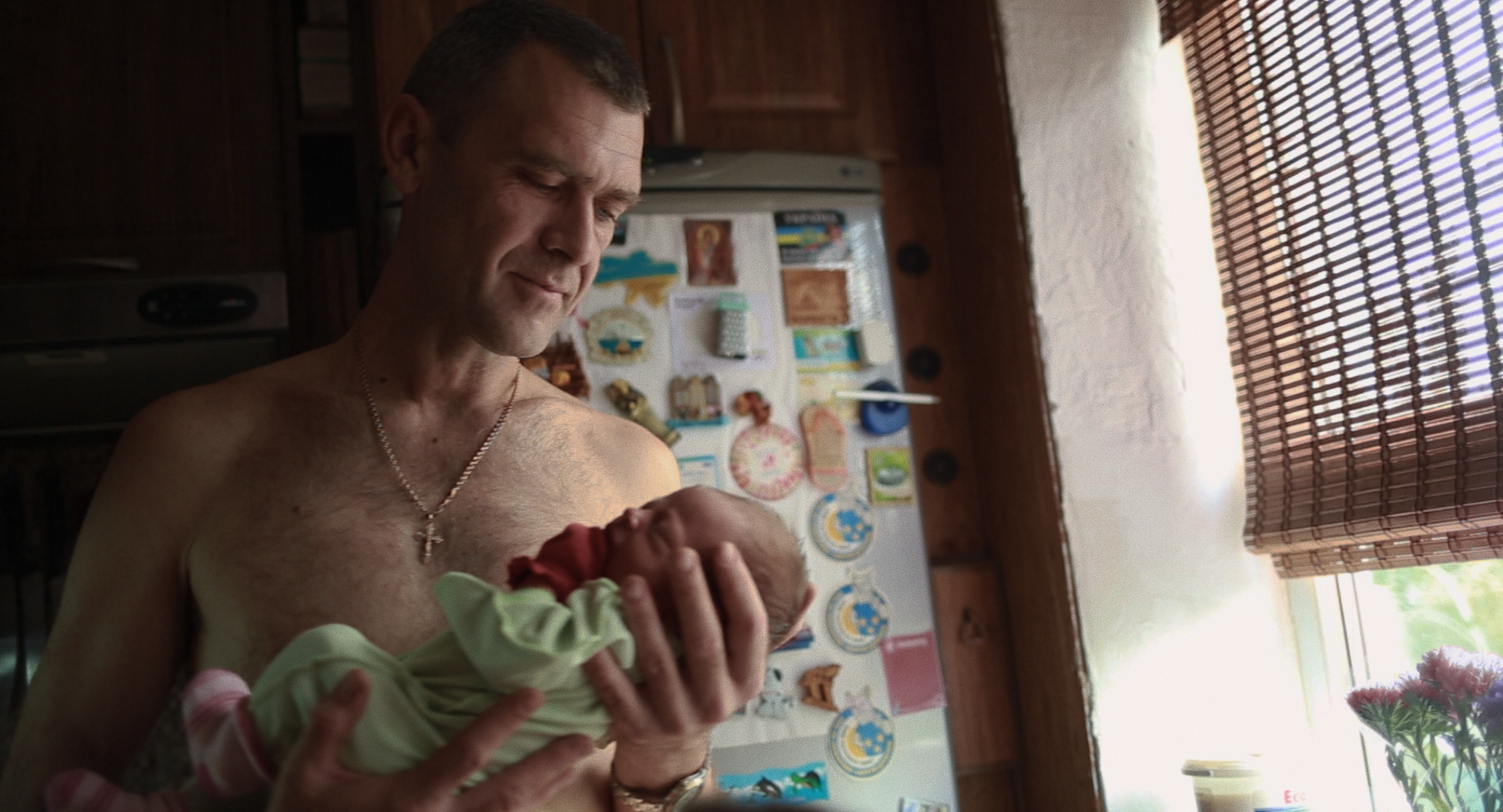
A 45-year-old war veteran who served in eastern Ukraine for three years, Serhiy was a war commander, responsible for his soldiers’ lives. He is a person of heart, with a sense of dark  army humour and pessimistic views on humanity. He works night shifts at the supermarket to support his family. He is a loving father but the war experience prevents him from fulfilling his dream of living a peaceful life with his family.

Nadiia

Serhiy's wife cared for their three sons while he served in the war. She is a very strong woman, a mother both strict and tender. Raising three boys made her extremely resilient. It's difficult for her to express her emotions and fragility. She doesn't work outside the home and mostly performs parental duties. She rarely has time for herself, or time alone. She gives everything she has to her children.

Sasha (11)

Eleven years old, Sasha is an introverted pre-teen who keeps his emotions to himself. He is going through adolescent insecurities and understands better than his brothers how much their father has changed. The tension between Serhiy and his oldest son, Sasha, grows throughout the film. The more Serhiy demands from Sasha, the more the boy rebels. By the end of the film, Sasha's behaviour will have changed, showing increased aggression towards his youngest brothers. Sasha also takes on more responsibility in caring for his newborn sister.

Artem (8)

Eight-year-old Artem is the most vulnerable child in the family. He is a very reflective boy. He cries and disagrees with his parents and brothers. Artem is fascinated by his father and his stories from the war; he learns war songs written by soldiers of the Russian-Ukrainian conflict. This son of Serhiy's has great empathy for his dad.

Nikita (3)

Three years old, Nikita is the youngest and sunniest child. He is the most open among all the children and the most cherished by his parents. He also becomes affected by his dad and the violence of his older brothers.

Marharyta

The newborn daughter, Marharyta – the only daughter among sons – brings hope to the family.

Lesia

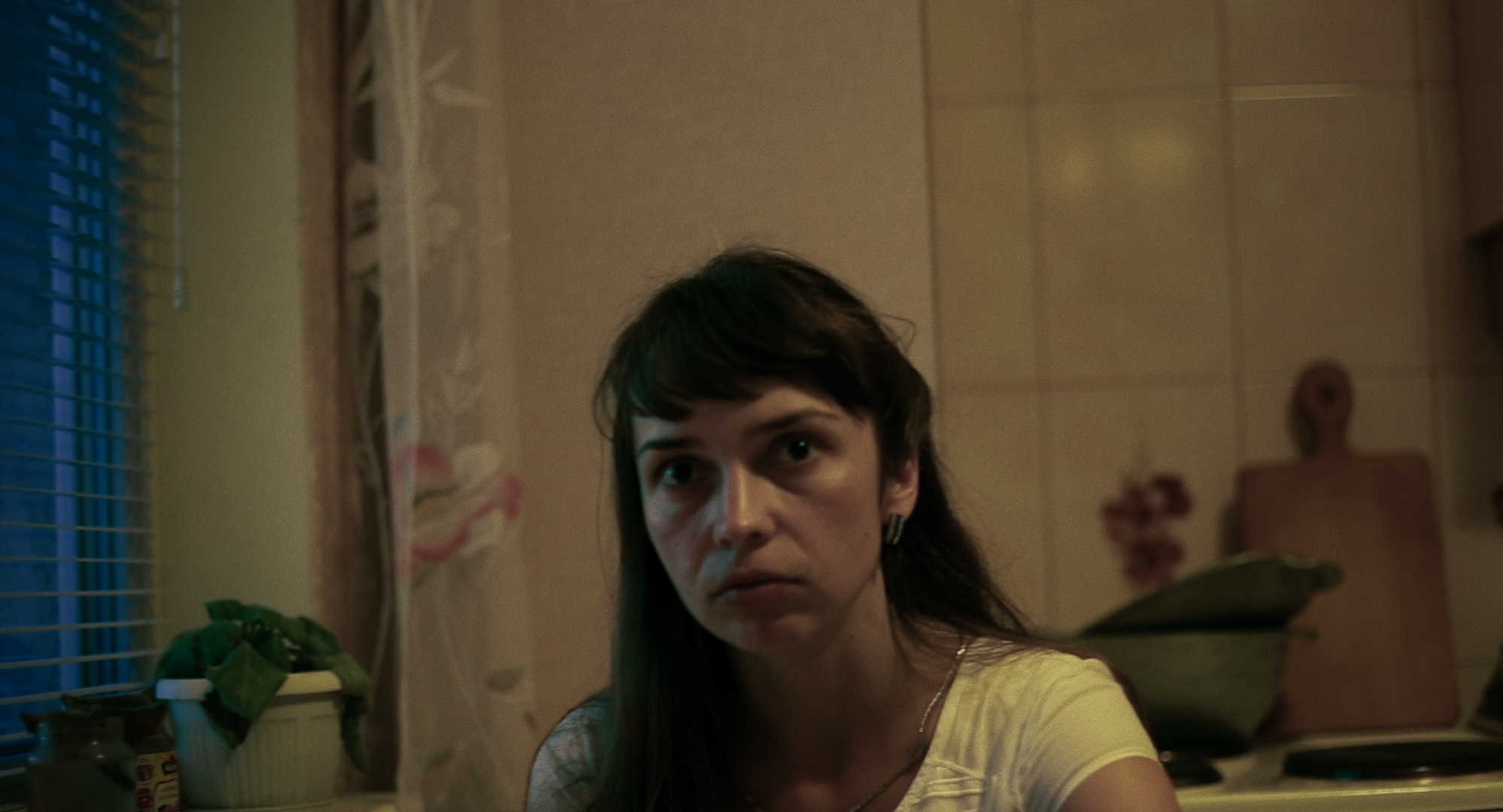
A 29-year-old woman, the film director, is going through a break-up with a war veteran. She is making a film about Serhiy's family to understand the impact of war on love and family relationships.

Producers Lesia Diak (main Producer), Monica Lăzurean-Gorgan, Elena Martin, Co-Producer Hrvoje Osvadić