Tag Archives: Festivals

A Decade with Alice (Alice On & Off)

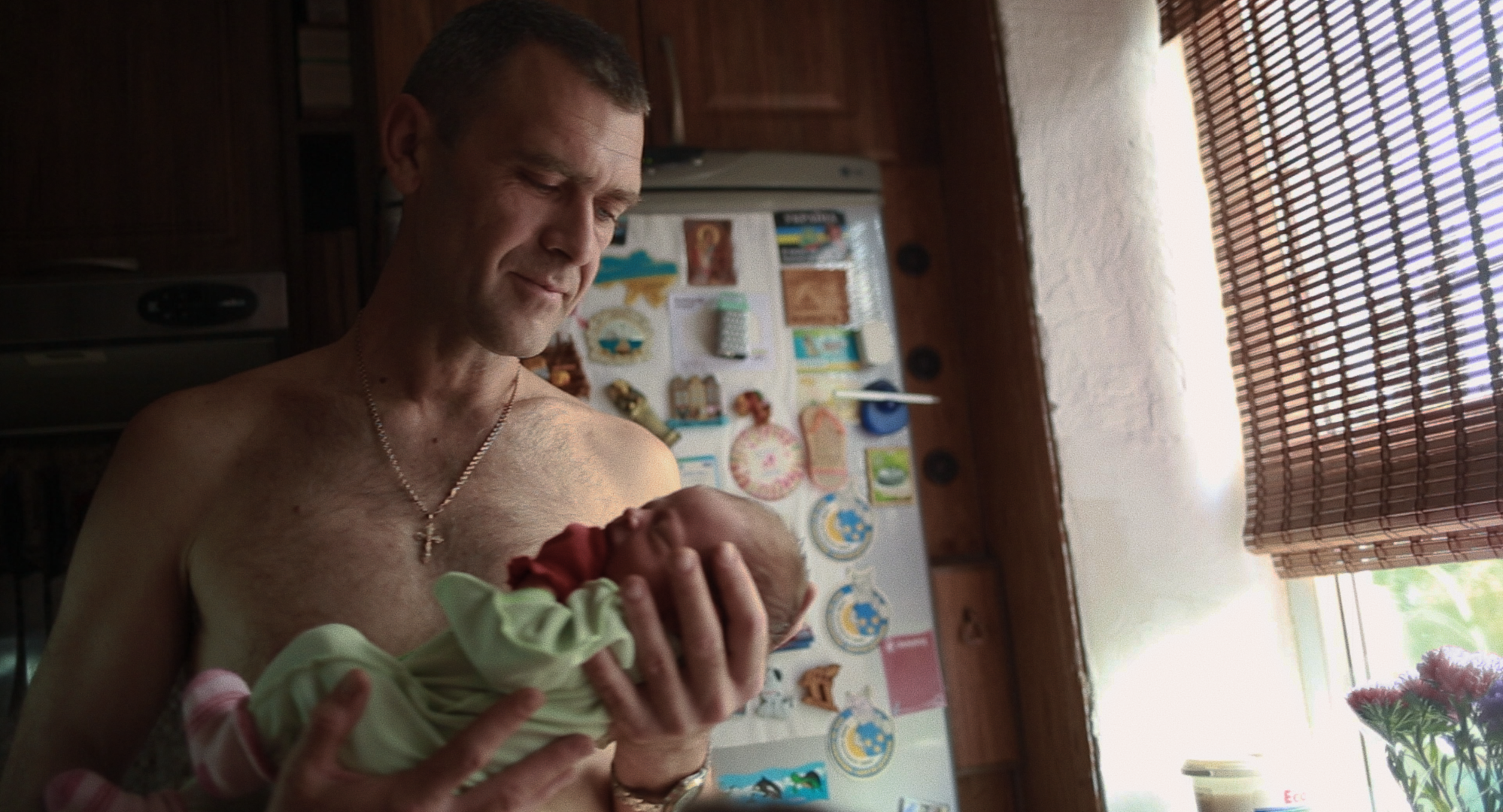
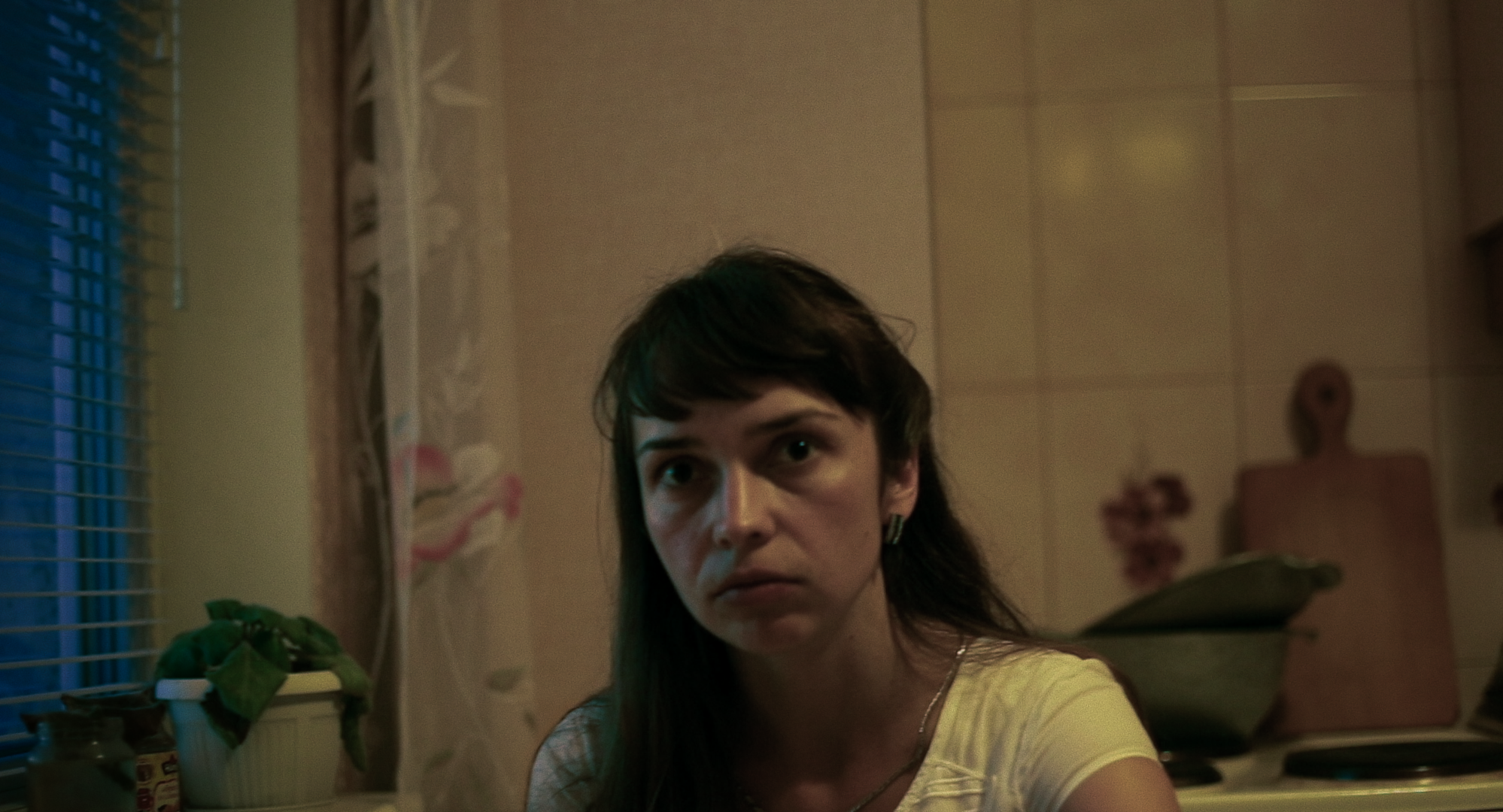
Dimitra Kouzi Interviews Isabela von Tent, Alice On & Off before the world premiere in the international competition at Krakow Film Festival 2024

Dimitra Kouzi: What made you stay with Alice and film her story for more than ten years?

Isabela von Tent: The story goes back to 2014. I was in film school and, for an exam, I needed to make a documentary portrait of someone interesting. I had just moved to Bucharest a year before and barely knew anyone outside of school. Back in my tiny hometown in Transylvania, things were different. So, I asked my classmates for suggestions on interesting subjects. One of them, who also happens to be the sound guy on the film, knew Dorian and thought he could be a good subject. I found out he had a very young wife, and that's how I met Alice.

DK: How did that first encounter go?

IT: We were both shy. At the first shoot, I was super polite, asking formal questions, and Dorian gave these long-winded replies. Alice was mostly taking care of their child. After a few days of filming with them, I finally built up the courage to ask Alice if she wanted to talk. She said yes, but only after asking Dorian's permission, which he casually gave.

DK: And what kept you coming back?

IT: In the beginning, it was the exoticness of their lifestyle that drew me in, something completely unfamiliar to me. It took me a while to realize that we had similar pasts. I was raised by grandparents too, and my childhood wasn't easy, not like hers, but I understood her feelings – that longing for love and guidance while growing up.

DK: What exactly made you curious about them?

IT: It was the first time I wasn't being told what to do. My grandparents were very strict, and here I had this chance to explore and find out who I really connected with. Meeting Alice was a special experience. It was a feeling in my gut, a strong instinct that told me I had to stick with her. After finishing the short film for school, I thanked them and moved on. Funny how things turned out, but I randomly ran into Dorian on the street later and asked him about Alice. He told me the sad story of their breakup and how Alice had to give up her studies at the Fine Arts University to focus on taking care of the family. This news coincided with needing another documentary project for my next school year. Slowly, the idea of making a feature film about their messy but captivating life together started to form.

DK: So, how much footage did you end up with after ten years?

This image has an empty alt attribute; its file name is 03_Alice_Poster_2024_04_09_web_EN.jpg

IT: Not so much – around 70 hours.

DK: And did the story come together in the editing room then?

IT: Exactly. A big turning point came when my short film about Alice won a National Film Academy Award. Irina (Malcea, Luna Film) is a member of the Academy, saw the film, and someone connected us. It was a lucky break because at 23, I wasn't prepared to approach producers on my own.

DK: How much did these ten years of involvement influence your own life and decisions? What kind of mark did that involvement leave on you?

IT: A lot. I think the biggest thing that happened to me during this process was that it helped me understand why I was acting the way I was. I mean, why I just wasn't myself. For a long time, I was very very upset with how my parents and grandparents treated me. Of course, therapy is an option, but this was my process, through Alice, through our developing relationship. She wasn't very forthcoming about her past. Letting her tell her story helped me understand my own. That's why I agreed to share a bit of my personal journey in the film. Training my patience was a challenge for me as well. Throughout this process, I was constantly honing my patience while surrounded by colleagues who were actively working on various projects and films.

DK: You made the brave decision to become part of the film.

IT: Yes, but that decision came later, I guess. It was made in the editing room, because that's when a lot of things became clear. Over these ten years, I think the awakening moment, the moment I truly understood what the film was about, came during editing.

This image has an empty alt attribute; its file name is marineci_IrinaMalceaIsabelaVonTent-243-2-1-1024x683.jpg

DK: How did the producer, Irina Malcea, help you get to that point?

IT: Irina fulfilled many roles for me. She was a mentor, a sister, and a very caring and loving friend.

DK: Did you ever feel like putting the camera down?

IT: No, I never felt like quitting. However, I was always very careful about how I filmed them. We have a lot of raw footage that's more aggressive, or grounded in reality, but I didn't include it because I didn't think it was essential.

DK: How about the scene where Aristo shuts his ears while they're fighting?

IT:  When I went home afterwards, I questioned myself a lot. Why didn't I put the camera down? Why didn't I call the police? The answer is, I think I was more scared than he was. For him, this was a kind of reality, and somehow, he knew how to cope with it. If I'd stopped filming, I would have chosen not to show a very important part of this child's life. Even though it's difficult to watch, and many people will criticize me for continuing to film, I'm more than happy to answer their questions and explain that I couldn't ignore this significant aspect of Aristo's life.

DK: How much responsibility do you feel towards Aristo in general? You've followed him from birth until now, when he's a young boy aged 11.

IT: I actually feel a lot of responsibility. I don't know if that's a good or a bad thing. I've heard many opinions on how to act or behave with your characters after filming is complete. But I choose to behave like a human. It's important to me to be part of his development, as much as he allows me to be, especially now that Dorian has just been diagnosed with cancer. We found out two weeks ago [April 2024]. So now I'm quite involved in what's happening with Aristo.

DK: That is very sad to hear. So what's happening with Aristo now?

IT: He's actually doing okay. He's continuing his martial-arts training, which has helped him develop a lot. He's changed a lot. He's a teenager, of course, a young teenager just starting his journey through those rough teenage years, but he's changed significantly. He looks healthier and more energetic. This sport has really helped him. I connected him with his trainer and helped him start training. It's been very beneficial for him. That's one way I'm helping him. Also, after his mother disappeared, I never stopped searching for her. We searched for her a lot.

DK: What other ethical challenges did you have to overcome? How did you manage to balance being an artist with making your film?

IT: It wasn't an easy journey to overcome the ethical questions. But most of the time, when I faced ethical dilemmas, I tried to imagine how I would feel if I were the character being filmed. I did this a lot and asked myself, 'Would I be comfortable with this?' We participated in many workshops where I shared my thoughts and fears with others, especially at Ex-Oriente and the Doku-Rough Cut Boutique. Those discussions helped us solidify the understanding that respecting the characters was the right approach. The rule, I think, was always to respect your character – respect Alice as a friend, respect her as a woman, and keep that in mind at all times.

DK: Would you say that your protagonists also learned something through this process?

IT: I want to believe that, after seeing the film, something changed within Alice. It was an hour and a half of roller-coaster emotions because it was the first time they were together in the same room, watching their lives unfold. I saw a shift in her, a sense that change might be coming. I don't know if it will happen in two months or three, but for the first time, she said to me, 'Thank you.' Just hearing her say 'Thank you' – it was very deep and heartfelt. She looked me in the eyes and said it, and that was very emotional for me.

DK: In general, Alice was very self-reflective in the film. I was very impressed by that. Do you think that's just how she is, or was it the filming process and your questions that brought that out?

IT: I think it was a combination of both her personality and her needs. The documentary process, the filming itself, became a way for her to be heard. She felt trapped in a family dynamic where she was solely responsible for providing – for the child, for Dorian – and her own needs were left behind. Talking to me, and having most of our conversations focus on her, I believe, created a balance that allowed her to be heard and to talk about herself.

DK: So, how would you describe Alice now that the film is finished? Now that you have some distance and perspective.

IT: I think Alice is an unloved girl, an unloved child trapped in a young woman's life. There's a lot of beauty within her that often goes unseen. She has a lot to offer. I saw the hope and the spark of joy within her. I truly wish that it will come back and that she will find the strength to overcome this very dark period in her life. She's vulnerable, but at the same time, she's powerful. Somehow, through her craziness and her courage to express her feelings authentically, she's grown. I saw the light in her paintings, a place where she felt safe. I saw the light when she played with her son.

DK: Can you reflect on the film's logline: 'How can you be loved if nobody has taught you how?'

IT:  It just emerged instantly. Mirroring myself through Alice's story, when I asked myself what I was missing in my personal development and what Alice was missing, the word 'love' came to mind.

DK: You refer to Dorian as an anti-hero.

IT: I appreciate him a lot for what he did for the child and how he helped Alice. When they met, she was in a very dark place, full of drugs and alcohol. He gave her hope. He had the emotional space to listen to her and encourage her to find a better path. He also gave her the space she needed to do that. But at some point, his darker side emerged – perhaps selfishness. He can be selfish when he wants to be, when his own interests take priority over their common ground. Interestingly, he was very aware of the camera.

DK: In what sense?

IT: In terms of his behavior. For example, remember the scenes where they were fighting? He was very quiet, uncharacteristically silent. I think, because he knew I was there, he put some limits on himself to avoid looking bad. During workshops, many people felt that Dorian wasn't all right, that he didn't always make good choices. On the other hand, you can't entirely blame him. We have beautiful footage of him caring for the child and taking care of Alice when she was younger. And after she left, he continued to care for the child. It's difficult to solely blame him for not always being honest.

DK: Where is Alice today? What's she doing?

IT: She has a new boyfriend, and from what I understand, he also struggles with drug addiction. She still visits her son often. I was surprised to see her at Dorian's place when I went to show them the film. She doesn't have a phone or internet access now, so I had no idea she would be there. I found her to be in a much better state than the last time I saw her, which was after an overdose. She was in a very bad shape then.

DK: Do you think there's a chance she can be saved or escape this path?

IT: She can escape it if she wants to. I can try to help her in a million different ways, but if she doesn't want, she won't be saved. 

DK: What emotions do you hope the audience experiences when they watch your film?

IT: I want them to question themselves. I've learned that uncomfortable feelings can reveal a very beautiful truth.

DK: Thank you, Isabela. It was a pleasure. I feel like I know you a bit better now. 

IT: Thank you for giving me this opportunity.

WORKSHOPS

BIOS

Isabela Von Tent, Director, DoP

Isabela's filmmaking journey began after she studied film directing and journalism.  She initially served as an assistant director on both national and international productions, collaborating with renowned Romanian filmmakers like Radu Jude and Tudor Giurgiu. These experiences provided invaluable training, but it was Isabela's unique perspective on reality and her passion for storytelling that drew her to documentary filmmaking.

Her debut in this genre, a short documentary, garnered the prestigious Romanian National Film Award. Driven by a desire to explore non-classical approaches to documentary storytelling, Isabela embarked on her first feature film. Shot over a span of ten years, this ambitious project led Isabela to participate in influential international training programs like Docu Rough Cut Boutique, ExOriente, and ZagrebDox Pro.

FILMOGRAPHY

All the Names that Start with C (2016), 14 min

short fiction

  • Festivals: Anonimul IFF, Romania 2016; STIFF Student International Film Festival, Croatia 2016

Chat with Alice (2015)

short documentary, 20 min

  • Cinemaiubit ISFF 2015 Awards: Best Short Documentary
  • Gopo Awards 2016: Best Short Documentary Film
  • Visegrad Film Forum: Case Study
  • Alter-Native 24, Tg Mures: Official Selection
  • STIFF International Student Film Festival, Croatia: Official Selection
  • Toamna La Voronet International Film Festival: Special Mention
  • Astra Film, Sibiu, Romania, 2016: Official Selection
  • DocuArt Fest, Bucharest, Romania 2016: Official Selection

Alice (2014)

Short documentary, 7 min

  • Cinemaiubit ISFF 2014, Victor Iliu Prize for Best Director of Short Documentary Film
  • Premiile Gopo 2015: Nominated for Best Short Documentary Film

What more can a documentary be?

As the future fast approaches, Dimitra Kouzi, raises questions about how evolving technologies are impacting the way we produce and present information
published in Modern Times Review (the European Documentary Magazine) autumn issue 2018.


Talking about Festivals

The Industry talks start tonight with the profile of a few quite interesting international festivals. Moderated by Susanne Guggenberger in the Pfeffermühle Café, the Talks with industry experts and producers/filmmakers,cover topics such as distribution and marketing options for your film and transmedia project, as well as specifics of markets, their players and introductions to festival programmers. So tonight we will meet festival programmers and find out what they are looking for! Neasa Ni Chianain, Guth Gafa International Documentary Festival, Falcarragh, Ireland (tbc), Galla Bador, Doc Aviv, Tel Aviv, Teddy Grouya, American Documentary FF, Palm Springs, Lulu Ratna, Doc Shot Indonesia,Yogyakarta (tbc), and Ana de la Rose Zamboni, IFF Guadalajara, Mexico.

If you want to know more about festivals check out filmfestivallife.com.

Sheffield 2013

MeetMarket Projects 2013 (June 12-16 2013)

In 2013 they have selected 63 unique projects involving 18 countries. The chosen projects covered the entire spectrum of factual media, crossing from TV to Cinema to Online, and everything over, above, between and beyond. These 63 projects where selected from the record total of 614 submissions received this year. They’re entertaining, innovative, clever and forward-thinking (so the festival). They make ideal partners for matchmaking with the best Decision Makers out there.

The Projects

#OP (Austria) - blue+green communication (Producer/Director - Friedrich Moser)

Approaching Futures (France) - Les Films d'Ici 2 (Producer - Virginie Guibbaud, Director - Xavier Marquis)

Aquarela (UK) - Aconite Productions (Producer - Aimara Reques, Director - Victor Kossakovsky)

Archive Fever (Israel) - Producer/Director - Karnit Mandel

Around the World in 80 Orgasms (UK) - Defacto Films (Producer - Paul Pauwels, Director - Emma George)

Art War (Germany) - HELDENFILM (Producer/Director - Marco Wilms)

BE BIG - Villian or Hero (Denmark) - Plus Pictures (Producer - Mette Heide, Director - Kaspar Astrup Schröder )

Birth of a Tiger (UK) - Century Films (Producer - James Gold, Director - Sam Benstead)

The Chimpanzee Complex (Netherlands) - Basalt Film (Producer - Simone van den Broek, Director - Marc Schmidt)

Chumbawamba: The Tubthumping One Hit Wonders (UK) - Dandy Films (Producer - Rachel Wexler, Director - Dunstan Bruce)

Churchill, A Giant in the Century (France) - ROCHE Productions 9Producer - Dominique Tibi, Director - David Korn-Brzoza)

Concerto (UK) - Seventh Art Productions (Producer/Director - Phil Grabsky)

Contact (Italy) - Ballandi Arts (Producer - Alessandro Carroli, Director - Gianluigi Attorre )

The Destruction of Memory (Australia) - Vast Productions (Producer - Joanna Buggy, Director - Tim Slade)

Dr Conti and Mr K (UK) - Met Film Production (Producer - Al Morrow, Director - Jerry Rothwell )

Europe for Sale (Italy) - GraffitiDoc (Producer - Enrica Capra, Director - Andreas Pichler)

Freightened (Spain) - Polar Star Films (Producer - Carles Brugueras, Director - Denis Delestrac)

The Grandmas Project (France) - Chaï Chaï Films (Producer - Laurence Bagot, Director - Jonas Pariente)

I draw the World (Netherlands) - Submarine (Producer - Femke Wolting, Director - Noud Holtman)

Ice Queens (Finland) - napafilms ltd (Producer - Liisa Juntunen, Director - Christy Garland)

THE INCREDIBLE ADVENTURES OF MIGUEL LITTIN (USA) - KA Snyder Productions (Producer - Kim A. Snyder, Director - Jeremiah Zagar)

In Search of Flynn (UK) - De La Warr Films (producer - Alex Gibney, Director - Julia Stovell)

Landscape of Life (UK) - BLTV LTD (Producer - Bettina Walter, Director - Ben Lewis)

The Leaderless Revolution (UK) - Hopscotch Films (Producer - John Archer, Director - Iain Scollay)

Light Fly, Fly High (Norway) -Fri Film AS (Producer/Director - Susann Oestigaard and Beathe Hofseth)

like ants for sugar (India) - Pickle Jar (Producer/Director - Shirley Abraham, Amit Madheshiya)

Little Yellow Boots (Finland) - Millennium Film Ltd (Producer - Kristiina Pervilä-Andersson, Director - John Webster )

The Look of Silence (Denmark) - Final Cut for Real ApS (Producer - Signe Byrge Sørensen, Director - Joshua Oppenheimer)

MARATHON MAN (UK) - Rare Day (Producer - Peter Dale, Director - David Belton)

Marlon Brando (France) - Roche Productions (Producer - Dominique Tibi, Director - Philippe Kohly)

Miners Shot Down (South Africa) -Uhuru Productions (Producer- Brian Tilley, Director - Rehad Desai)

Moscow Tabloid (Ireland) - Cutstone Productions Limited (Director - Michael Doyle)

Neither God nor Master - a history of anarchism (France) -Temps noir (Producer - Tancrede Ramonet, Director - Patrick Barberis)

No Place for Children (UK) - Smoke & Apple Films (Producer - Bronwen Parker- Rhodes, Director - Katie Green)

No Regrets (Denmark) - Profile Pictures (Producer - Ditte Milsted, Director - Sun Hee Engelstoft)

Nothing to Envy (UK) - Mosaic Films (Producer - Carol Rodger, Director - Andy Glynne)

ORION - The Mask of Elvis (UK) - Glimmer Films (Producer/Director - Jeanie Finlay)

THE PHILIP K DICK EXPERIENCE (France) - Nova production (Producer - Thibaut de Corday, Director - Brice Roy)

Power and Impotence, a tragedy in 3 acts (France) - Black Moon (Director - Anna Recalde Miranda)

Putin is Back (France) - Les Films Grain de Sable (Producer - BEN JAMAA Sallah-Edine, Director - Jean-Michel Carré)

THE QUATRARO MYSTERY (Denmark) - sonntag pictures (Producer - sara stockmann, Director - Jeppe Rønde )

Raging Grannies (Norway) - Faction Film AS (Producer - Christian Falch, Director - Håvard Bustnes)

REACH FOR THE SKY (Belgium) - Visualantics (Producer - Gert Van Berckelaer, Director - Steven Dhoedt)

Rebel Rebel (Denmark) -Fridthjof Film (Producer - Jesper Jack, Director - Camilla Arlien-Søborg)

The Secret Flight (Denmark) - Fridthjof Film (Producer - Miriam Nørgaard, Director - Andreas Koefoed)

The Shadow World (USA) - Louverture Films (Producer - Joslyn Barnes, Director - Johan Grimonprez)

SHOOTER (USA) - Marshall Curry Productions (Producer/Director - Marshall Curry)

The Singing Hospice (UK) - SDI Productions Ltd (Producer - Sonja Henrici , Director - Amy Hardie)

Slum School - A documentary Musical (UK) - Century Films (Producer - Katie Bailiff, Director - Brian Hill)

Small Town Big Story (USA) - 10-Spot Syndicate (Producer - Tyler Measom, Director - Julian T. Pinder)

Swinging Addis (UK) - Mango Films (Producer - Christopher Pencakowski, Director - Henrique Goldman)

The Term (Estonia) - Marx Film (Producer - Maxim Tuula, Director - Pavel Kostomarov)

Thomas Quick: The Making of a Serial Killer (UK) - Century Films (Producer - Katie Bailiff, Director - Brian Hill )

TO HAVE AND TO HAVE NOT (Italy) - VisitorQ (Producer - Cristina Rajola, Director - Vincenzo De Cecco)

Two Children of the Red Mosque (USA) - Changeworx (Producer - Jonathan Goodman Levitt, Director - Hemal Trivedi)

Waiting for Giraffes (Netherlands) - Volya Films (Producers - Denis Vaslin & Fleur Knopperts, Director - Marco de Stefanis)

WE NEVER SLEEP (UK) - Duffel Films (Director - Michelle Fox)

What Do We Want? (UK) - Spanner Films Ltd (Producer - Lizzie Gillett, Director - Franny Armstrong)

Who's Gonna Love Me Now? (Israel) -Heymann Brothers Films (Producer - Barak Heymann, Director - Tomer Heymann)

WOMAN OF THE YEAR – STAR OF THE CENTURY - The great Katharine Hepburn (Germany) - FLORIANFILM GmbH (Producer - André Schäfer, Director - Rieke Brendel)

The Wonderful Kingdom of Papa Alaev (Israel) - Noam Pinchas and Tal Barda (Co-Director and Co-Producer)

Zapped (France) - Les Films du Poisson (Producer - Estelle Fialon, Director - Thorsten Schütte

Films to watch in Thessaloniki Documentary Festival 2013

TDF Poster
Films to watch in Thessaloniki Documentary Festival, starting March 15, 2013:

  • One Step Ahead, a film by Dimitris Athiridis on Yannis Boutaris, mayor of Thessaloniki (ERT/ARTE co-production)
  • To the Wolf, on two families of shepherds living in a mountainous region in the Peloponnese, by Aran Hughes and new-comer Christina Koutsospyrou, which also participated in this year’s Berlinale,
  • Little Land, by Nikos Dayandas, based on my original idea and research (ERT/ARTE Anemon co-production), filmed on location in the magical island of Ikaria
  • Hardships and Beauties, by Kimon Tsakiris, starring a farmer-cowboy in Messinia (ERT/ARTE co-production)
  • Hippie! Hippie! Matala! Matala!, a documentary on the 1960's hippie scene on Crete, with excellent archival material and a great sense of humour, produced by ERT with research and script by Maria Koufopoulou and directed by Yorgos Varelas
  • Democracy The Way of the Cross, by Markos Gastin
  • a film on the Greek anarchist poetess Katerina Gogou by Antonis Boskoitis Reinstating the Dark Side (also screened at Danaos Cinema in Athens until Wednesday March 20)
  • Salma, a girl in India, a film by Kim Longinotto, a great director of films on women,
  • Cassandra's Treasure, on the controversy surrounding the gold mine in Halkidiki, in northern Greece, by Yorgos Avgeropoulos,
  • the special tribute for the festival’s 15th anniversary (watch out for my special post to follow), and of course
  • the tribute to Chilean director Patricio Guzmán, with nine of his films. Unfortunately the director broke his leg and cannot attend - Patricio, get well soon!

“This Ain´t California”: the debate at Prix Europa 2012!

Prix Europa, October 20-27, 2012, Berlin

This Ain´t California, Germany, 96 min., 2011, was nominated for the TV Documentary category.

A few words about the film from the Prix Europa catalogue:

In 90 minutes, we see the GDR more sharply, more clearly: the skater subculture shows that not all was grey-on drab clouds of Trabant fumes. This film takes original clips of the "wheel-board rides" - straight out of East Germany in the 80s - and mixes it with animations and re-encounters with the protagonists today in a documentary narrative.
After the debate at Prix Europa 2012 about the film, the producer chose to withdraw the film from the competition.


This Ain't California has already following awards: 
Berlinale Interntational Film Festival – DIALOGUE EN PERSPECTIVE AWARD
Lighthouse International Film Festival - SPECIAL JURY PRIZE 2012
Nashville Film Festival – SPECIAL JURY PRIZE FOR ACHIEVEMENT IN DIRECTING
Filmkunstfest Schwerin – AWARD FOR PROMISING YOUNG TALENTS
Festival’s Selection:
Karlovy Vary Film Festival – Documentary Competition
Latest news : THIS AIN’T CALIFORNIA is among the short listed German candidates for the 2013 Oscar for Best Foreign Language Film.

Also nominated at Prix Europa for the TV DOCUMENTARY awards 2012 were:

Danube Hospital, Austria, 75 Min.
Amateur Filmmaker, Belarus, 28 Min.
The Court, Belgium, 40 Min.
The War Reporter, Croatia, 60 Min.
A Split Second - 10 Stories From The Roads, Denmark, 56 Min.
Forever Yours, Finland, 77 Min.
Ballad For A Queen, France, 91 Min.
The Century Of Cartier-Bresson, France, 53 Min.
The Algerian War, The Fracture, France, 57 Min.
The Khmer Rouge And The Man Of Non - Violence, France, 87 Min.
This Man Is A Multi-Layered Cake, France, 57 Min.
Hitler´s Children, Germany, 78 Min.
Munich 1970- When The Terror Came To Us, Germany, 91 Min.
The Second Execution Of Romell Broom, Germany, 89 Min.
Meet The Fokkens, The Netherlands, 77 Min. (the winner of Prix europa 2012)
Stuff Everywhere, The Netherlands, 57 Min.
Back To The Square, Norway, 85 Min.
Doctors, Poland, 81 Min.
Vera Gran, Poland, 76 Min.
My Name Is Druillet, Spain, 67 Min.
He Thinks He´s The Best, Sweden, 76 Min.
Ahead To The Past, Switzerland, 52 Min.
Alex: A Life Fast Forward, United Kingdom, 58 min.

Die DDR ist nicht Kalifornien

Doku über Skater in der DDR

Von Knut Elstermann (Frankfurter Rundschau 1.8.2012)

Marten Persiels dokumentarische Filmerzählung „This Ain't California“ lief als Überraschungshit auf der diesjährigen Berlinale. Er zeigt, wie sich in den 1980ern eine bis heute kaum bekannte Skater-Szene in der DDR etablierte.

Die DDR bemühte sich nach außen hin geradezu verzweifelt um eine Aura des „Weltniveaus“. Sie wollte ganz oben mitspielen, plusterte sich auf und wäre so gern einer der zehn führenden Industriestaaten der Welt gewesen. Manch einer hielt das tatsächlich für die Realität. Nach innen pflegte die DDR allerdings einen piefigen Provinzialismus, in dem schon die Sprache Bastionen gegen die westliche Lebensart bilden sollte.

Der Begriff „geflügelte Jahresendfigur“ für Weihnachtsengel dürfte zwar eine witzige Nachwende-Erfindung sein, aber die „Grillette“ für den Hamburger und die „Ketwurst“ für den Hotdog gab es wirklich. Aus dem schnittigen Skateboard wurde das behäbig klingende „Rollbrett“: eine im Grunde überflüssige Wortschöpfung, denn offiziell existierten diese Geräte in der DDR gar nicht.

This Ain´t California

Der Film „This Ain’t California“ lief als Überraschungshit auf der diesjährigen Berlinale. Er zeigt wie sich in den 1980ern dennoch eine bis heute kaum bekannte, fantasievolle Skater-Szene in der DDR etablierte und wie die rollenden Bretter auch hier sehr viel mehr waren als nur Sportutensilien. Sie wurden zu Symbolen einer autonomen, subversiven Jugendkultur. Bezogen wurden die „Rollbretter“ im besten Fall aus dem Westen. Viele entstanden jedoch in emsiger Heimarbeit, liebevoll aus Holz und Rollschuhen zusammengebastelt und geschraubt. Diese kostbaren Unikate sind eindrucksvolle Zeugnisse ostdeutscher Findigkeit und Improvisationslust.

In „This Ain’t California“ rasen Dirk und Nico auf solchen Brettern durch die Plattenbausiedlungen Magdeburgs, später stößt Denis als Dritter im Freundschaftsbund zu ihnen. Er wird „Panik“ genannt – womit sehr treffend das energiegeladene, unangepasste, anarchische Wesen des jungen Mannes beschrieben ist, der als Abwesender dennoch im Zentrum des Films steht. Er, der jeden Zwang, jede Ordnung, jedes feste System ablehnte, ist als Bundeswehrsoldat beim Afghanistan-Einsatz umgekommen. Sein Begräbnis führt die Gefährten noch einmal zusammen. Sie erinnern sich.

Von Magdeburg aus waren sie einst nach Ost-Berlin gezogen, hatten eine fröhliche Wohngemeinschaft gebildet und die endlosen Leerflächen des Stadtzentrums für ihre Skater-Künste genutzt. Besonders schön zu sehen ist das bei einer rasanten Abfahrt auf den gewaltigen Betonzacken am Eingang des Fernsehturms. Bis zur Euroskate 1988 in Prag, dem ersten Skater-Treffen im Ostblock, führte ihr von der Staatssicherheit beargwöhnter Weg. Kurz vor dem Mauerfall wurde Denis verhaftet.

Der erste Kinofilm des Regisseurs Marten Persiel, der im Westen aufwuchs und selbst jahrelang als Skater unterwegs war, spiegelt das Lebensgefühl junger Leute in der Spätphase der DDR erstaunlich authentisch wider. Sie rieben sich nicht mehr am Staat und dessen ausgehöhlten Idealen; sie ignorierten ihn, so gut es eben ging, und führten in der Nische ihr bewegtes Leben. Sie waren, wie die drei Freunde auf ihren Brettern, immer wendiger und witziger als die schwerfällige Macht.

Diese Jungs führten ein bewegtes Leben in Berlin, Hauptstadt der DDR.

Diese Jungs führten ein bewegtes Leben in Berlin, Hauptstadt der DDR.
Foto: Farbfilm-Verleih

Und so schildert der Film auch keinen verbissenen Kampf gegen den Staat, sondern die Normalität des Alltags, kurioserweise anhand des wirklich nicht alltäglichen Motivs des Skatens. „This Ain’t California“ verteidigt den Wert gelebten Lebens, stemmt sich mit seiner Buntheit und Verspieltheit gegen das übliche Einheitsgrau in der Darstellung von DDR-Verhältnissen und liefert fast nebenbei auch eine melancholische Liebeserklärung an eine relativ unbekümmerte Jugend. Diese Zeit erscheint als eine Art Sehnsuchtsära, welche die Helden dieses Films jedoch ebenso wenig wieder betreten können wie den verschwundenen Schauplatz ihres provokanten Übermutes, die DDR.

„This Ain’t California“ wurde vom Verleih als Dokumentarfilm deklariert. Der Film ist indes ein kleines Wunderwerk der assoziativen Montage, das trotz seiner kleinteiligen Vielfalt nie überladen, beliebig oder verwirrend wirkt, vielmehr schwungvoll den Rhythmus der waghalsigen Skater aufnimmt.

Seltenes Archivmaterial, private Super-8-Aufnahmen und gezeichnete Animationen verbinden sich mit gespielten Szenen – die allerdings nicht als solche gekennzeichnet werden und ein gewisses Unbehagen erzeugen. Nicht nur der angebliche Stasi-Mann sagt eindeutig auswendig gelernte Texte auf. Bei manchen Szenen schimmert die kunstvoll natürliche Inszenierung durch. Und so ist auch der Hauptheld, der im Krieg getötete „Panik“, gar keine wirkliche Person, sondern ein Kompositum aus mehreren Biografien.

Das provoziert grundsätzliche Fragen. Welchen Bildern kann man hier trauen? Während ihres Triumphzugs durch die Festivals räumten die Filmemacher die Fiktionalität ihres Verfahrens scheibchenweise ein. Inzwischen sprechen sie offen von einer „dokumentarischen Erzählung“, was es ganz gut trifft und diesem Film von Beginn an dienlicher gewesen wäre als die Verhüllung der Methode.

Im sehr freien Spiel mit dem dokumentarischen und dem fiktiven Material gelang ja am Ende ein glaubwürdiges Abbild des echten Lebensgefühls in der DDR, das Empfinden persönlicher Freiheit inmitten gesellschaftlicher Begrenzungen. Vielleicht stimmt in diesem Film so gut wie nichts, aber alles ist wahr.

This Ain’t California, Dtl. 2012. Marten Persiel, Drehbuch: Marten Persiel, Ira Wedel, Kamera: Felix Leiberg. 99 Min., Farbe. FSK ab 12.

(Frankfurter Rundschau 1.8.2012)
 

CineDoc Documentary Festival: 2012-13

September 2012 – April 2013, French Institute, Athens

Parallel Screenings in Athens, Thessaloniki, Chania, Patras, Nicosia

CineDoc CineDoc is an innovative media initiative that screens international award-winning documentaries. It has been organized since 2009 by Rea Apostolides, Avra Georgiou and Dimitra Kouzi, in cooperation with the French Institute at Athens and Anemon Productions, and is supported  by the Goethe Institute at Athens, the British Council at Athens, the Danish, Finnish, Norwegian, and Swedish Embassies in Greece, the Norwegian Institut at Athens and Filmstransit International.CineDoc collaborates with Danaos Cinema (Athens) Pavlos Zannas Cinema and the Thessaloniki Cinema Museum (Thessaloniki), Cine-Μathimata (Chania), Gymnos Ofthalmos, Lithografeio Theatre (Patras) and Brave New Culture (Nicosia), where the CineDoc programme is screened in parallel. The screenings are accompanied by special events aimed at inspiring community action and bringing together documentary professionals.

Organization – Programme Selection: Rea Apostolides, Avra Georgiou, Dimitra Κouzi
Production – Coordination: Electra Peppa
Communication: Dimitra Kouzi
Social Media: Irini Panagopoulou
Text Translation – Editing: Dimitris Saltabassis
Catalogue Graphic Design:  Penny Zevoli
Parallel screenings in collaboration with:  Ilias Georgiopoulos (Danaos Cinemas), Notis Forsos (Pavlos Zannas Cinema and Thessaloniki Cinema Museum), Yiangos Hadjiyiannis  (Brave New World), Matthaios Frantzeskakis (Cine-Mathimata), Nikolaos Kavvadias and Elena Alexandraki (Gymnos Ofthalmos, Lithografeion Theatre)

 The 2012-13 programme in detail:cinedoc 12_13-1

How to start a revolution, στο CineDoc την Τετάρτη 17 Οκτωβρίου στις 20.00

Ruaridh Arrow/52’/2011/UK, Egypt, Serbia, Montenegro, USA

Στα 83 του, ο ηλικιωμένος Αμερικανός καθηγητής του Χάρβαρντ Τζην Σάρπ, δις υποψήφιος για Νόμπελ Ειρήνης, ζει σε μια εργατική γειτονιά της Βοστώνης και περιποιείται τις ορχιδέες του. Ο Gene Sharp πιστεύει πως η μη βίαιη δράση δεν είναι απλώς παθητική αντίδραση, αλλά το καλύτερο και πιο αποτελεσματικό όπλο που διαθέτει ένας λαός. Ίσως για αυτό βρίσκεται στην πρώτη θέση των 100 πιο σημαντικών στοχαστών του 2011 σύμφωνα με το περιοδικό Foreign Policy.

Τα τελευταία 50 χρόνια, ο Σαρπ είναι ο κορυφαίος θεωρητικός της μη βίαιης δράσης. Στο πιο γνωστό βιβλίο του, Από τη δικτατορία στη δημοκρατία (εκδ. Ινστιτούτου Άλμπερτ Άινσταιν), που έγραψε το 1993 για τη Βιρμανία, περιγράφει 198 τρόπους μη βίαιης δράσης κατά απολυταρχικών καθεστώτων. Στο ντοκιμαντέρ How to start a revolution, το θέμα είναι φυσικά ο ίδιος ο Σάρπ, και οι τρόποι με τους οποίους η σκέψη του έχει επηρεάσει τα κινήματα διαμαρτυρίας της εποχής μας.

Θα προλογίσει ο Πέτρος Τατσόπουλος.

Διαβάστε επίσης τη συνέντευξη του Τζην Σαρπ στο Βήμα.

Γαλλικό Ινστιτούτο, Σίνα 31, Τετάρτη 17 Οκτωβρίου στις 20.00

Τιμή εισιτηρίου: 6 ευρώ. Προπώληση: Βιβλιοπωλείο ΙΑΝΟΣ

Η ταινία προβάλλεται παράλληλα στους κινηματογράφους: Δαναός (Κυριακή 20/10/2012), Αίθουσα Παύλος Ζάννας (14/10) και Μουσείο Κινηματογράφου Θεσσαλονίκης (17/10/2012), καθώς και στον Γυμνό Οφθαλμό - Θέατρο Λιθογραφείον, στην Πάτρα (14/11/2012).

Φεστιβάλ Ντοκιμαντέρ CineDoc: τι θα δούμε το 2012-13

Το φετινό πρόγραμμα του CineDoc περιλαμβάνει 30 βραβευμένα ντοκιμαντέρ από την Ελλάδα και όλο τον κόσμο!

Μετά την προβολή έναρξης στις 26 Σεπτεμβρίου, με την ταινία Encardia η πέτρα που χορεύει, ξεκινάει το αφιέρωμα σε ανθρώπους που μας εμπνέουν. Η Πίνα Μπάους, ο Senna, πιλότος της Formula 1, ο John Lennon και ο Leonard Cohen, είναι μερικά από τα πρόσωπα που πρωταγωνιστούν στην επιλογή από τα ντοκιμαντέρ που κέρδισαν τα βραβεία Grierson, τα οποία προβάλλονται σε συνεργασία με το Βρετανικό Συμβούλιο. Το αφιέρωμα στη Γαλλία, τον Δεκέμβριο, περιλαμβάνει δύο πολλά υποσχόμενα ραντεβού: ένα με τον Ζακ Λακάν και ένα με την Κατρίν Ντενέβ.

Τον Ιανουάριο, το CineDoc αναζητά τις ρίζες της σύγχρονης γιόγκα, με μια ταινία-σταθμό, που ξεκινάει με τον σπουδαίο δάσκαλο Κρισναματσάρια και συνεχίζει με τους Πατάμπι Τζόις, Αϊένγκαρ και Σριμπασιάμ. Η ταινία έχει τίτλο The Breath of the Gods και περιλαμβάνεται στο  αφιέρωμα του CineDoc στην Ζωντανή Ιστορία.

Τον Φεβρουάριο, το CineDoc στρέφει το βλέμμα προς τον μακρινό Βορρά, με ένα μεγάλο αφιέρωμα με τίτλο North meets South. Από το τριάστερο εστιατόριο Noma στην Κοπενχάγη, στη σάουνα μαζί με Φιλανδούς, ως το Diyarbekir για μια συναυλία και από εκεί στα νησιά της Νορβηγίας, τον Oli Rehn, τις σχέσεις μεταξύ γυναικών τριών γενιών και την πράσινη ανάπτυξη που εξελλίσεται σε απειλή για την Ισλανδία. Στην διάρκεια ενός μήνα, οι θεατές του CineDoc θα ταξιδέψουν στον Βορρά και θα γνωρίσουν τον κόσμο μέσα από τα μάτια δημιουργών από τη Δανία, τη Νορβηγία, τη Σουηδία, τη Φιλανδία και την Ισλανδία. Με το εισιτήριο του CineDoc μπορείτε να απολαύσετε το ειδικό Σκανδιναβικό μενού στο εστιατόριο Safka στον Κεραμεικό.

Η άνοιξη του 2013 μυρίζει μελάνι και χαρτί, με ένα αφιέρωμα ντοκιμαντέρ με τίτλο Βιβλία και εκδότες, σε συνεργασία με το Ινστιτούτο Goethe. Το φετινό πρόγραμμα του CineDoc ολοκληρώνεται τον Απρίλιο, με μια επιλογή από ντοκιμαντέρ και διεθνείς συμπαραγωγές Ελλήνων σκηνοθετών για την Ελλάδα σήμερα, σε avant-premiere με αφορμή το 24ωρο αφιέρωμα στην Ελλάδα που προγραμματίζει το Γαλλο-Γερμανικό Κανάλι ARTE για τον Μάιο 2013.

Δείτε ένα τραγούδι με τους Encardia και την Enza Magnolo από τη ζωντανή τους εμφάνιση, μετά την εναρκτήρια προβολή του CineDoc 2012-13 στο Γαλλικό Ινστιτούτο Αθήνας (Τετάρτη 26 Σεπτεμβρίου 2012) με την ταινία Encardia, η πέτρα που χορεύει, του Άγγελου Κοβότσου (Βραβείο Κοινού Φεστιβάλ Θεσσαλονίκης).